Let's cut through the BS right now.
You've got a course idea (or maybe you've already built one), and you're staring at that pricing field like it's going to determine your entire financial future. Because honestly? It kind of will.
Here's what nobody tells you about how to price online courses for maximum revenue in 2026: the game has completely shifted from selling information to selling implementation. The gurus charging $47 for a "complete system" are leaving massive money on the table, while the smart operators are building pricing ladders that turn $47 buyers into $2,000+ customers.
After building multiple six-figure revenue streams through courses and communities, here's what actually works in 2026—not theory from someone who's never made a dollar online, but battle-tested strategies from the trenches.
Key Takeaways
- Tiered pricing is non-negotiable: Offering 3-5 price points (from $47 gateway offers to $2,000+ implementation bundles) captures different buyer segments and maximizes total revenue
- Implementation beats information: Courses with group support, accountability, and done-with-you elements command 3-10x higher pricing than DIY content alone
- Strategic discounting matters: Use 40-60% beta discounts for launches and 15-20% early-bird pricing for momentum, but avoid training your audience to expect permanent sales
- Payment plans increase conversions by 15-30%: For offers above $500, split payments into 3-6 months with a 10-15% premium over full-pay pricing
- Review and iterate quarterly: Evaluate pricing every 90 days based on conversion rates, completion rates, and revenue per student—not competitor pricing
The 2026 Pricing Reality: Why Your $97 Course Is Leaving Money on the Table
The online course market in 2026 looks nothing like it did even two years ago.
Information is now worthless. Seriously. Your students can find 90% of what you're teaching on YouTube for free. The value isn't in the information anymore—it's in the implementation, accountability, and transformation.
This is why the pricing benchmarks have completely shifted:
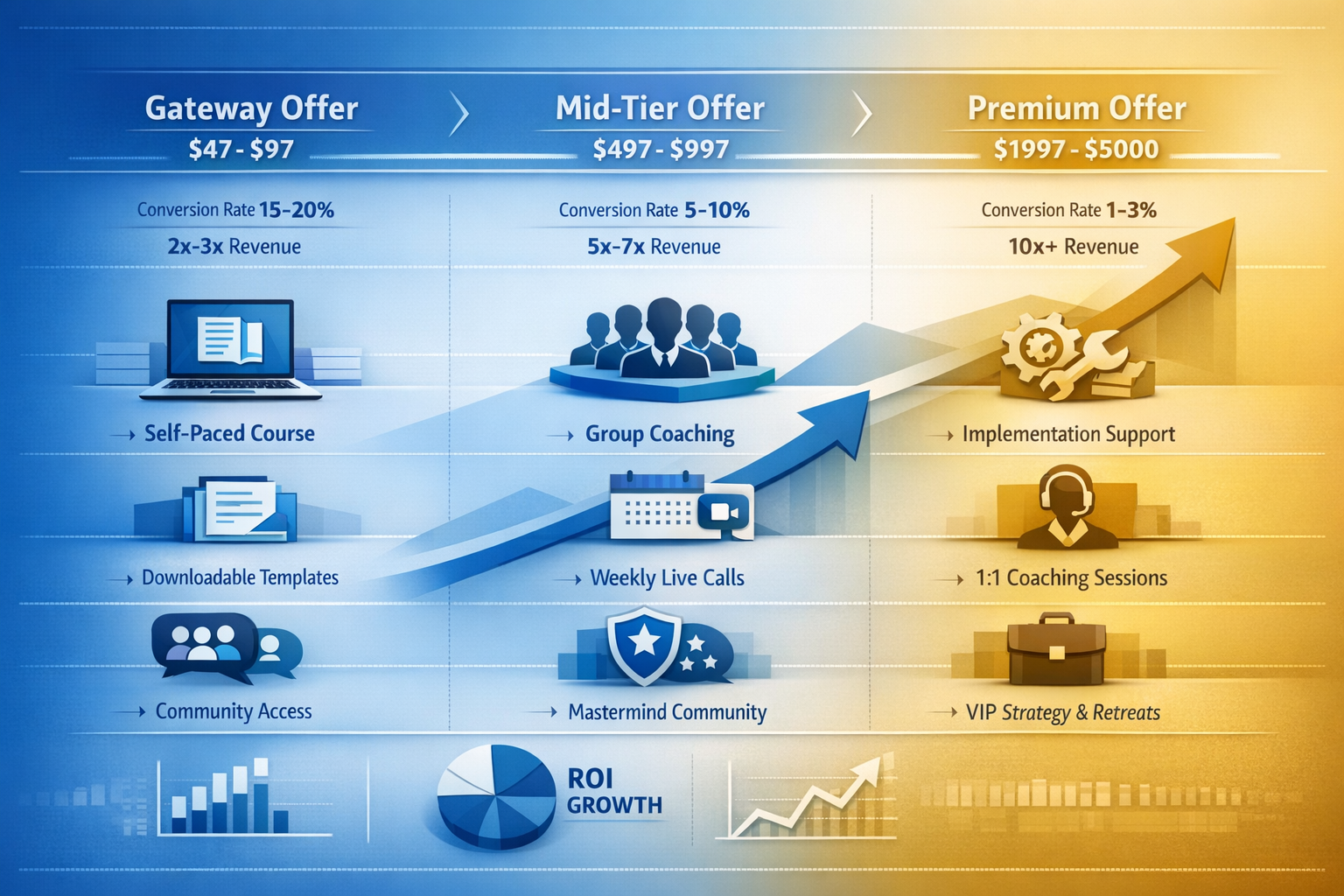
- Low-ticket gateway offers: $47-$97 (self-paced, minimal support)
- Mid-tier group programs: $497-$997 (community access, group coaching)
- High-ticket implementation: $1,997-$5,000+ (done-with-you, accountability, live support)
- Subscription models: $20-$299/month (ongoing access, continuous value)
Sound familiar? You're probably pricing based on what feels "fair" or what your competitors charge, not based on the actual value you deliver.
That's the first mistake.
The second mistake? Thinking you need to pick ONE price point. The operators making real money in 2026 are building pricing ladders that meet buyers wherever they are[1].
The Pricing Ladder That Actually Works
Here's the framework that took me years to figure out:
Gateway Tier ($47-$97): Self-paced course, basic templates, email support only. This is your low-risk entry point that builds trust and proves you know your stuff.
Core Tier ($297-$497): Everything in Gateway plus community access, monthly group Q&A calls, and implementation worksheets. This is where most of your volume happens.
Premium Tier ($997-$1,997): Everything in Core plus weekly accountability calls, template customization, and direct feedback on your work. This is where your profit margins explode.
Elite Tier ($2,997-$5,000+): Done-with-you implementation, private coaching calls, and guaranteed results. Limited spots, maximum transformation.
The beauty of this model? Someone who buys your $47 gateway offer and gets results will naturally want more support. You're not leaving money on the table—you're creating an ascension path[2].
Understanding Value Stacking: How to Justify Premium Pricing Without Feeling Sleazy
Let's talk about why some courses command $2,000 while others struggle to sell at $97.
It's not about the number of videos. It's not about how many hours of content you have. It's about the value stack.
Here's what actually adds perceived (and real) value to your course pricing:
Core Content (Baseline Value)
Your actual course modules establish the foundation. In 2026, this alone isn't enough to command premium pricing. It's table stakes.
But here's where it gets interesting…
Templates & Swipe Files (+$50-$200 Value)
Done-for-you templates that students can customize add immediate implementation value. These cut down the time-to-result dramatically.
Think: email sequences, sales page templates, social media calendars, spreadsheet calculators. Anything that eliminates the "blank page problem" adds real value[2].
Community Access (+$100-$500 Value)
A properly moderated community (not a ghost town Facebook group) where students can get peer feedback, share wins, and stay accountable is worth hundreds in perceived value.
This is where platforms like Skool shine—the gamification and structured community features create engagement that justifies higher pricing.
Live Group Coaching (+$300-$1,000 Value)
Weekly or bi-weekly group calls where you answer questions, review student work, and provide real-time guidance transform a course from "information product" to "coaching program."
Cohort-based courses with live elements command 2-3x the price of equivalent self-paced content because completion rates skyrocket when peer accountability exists[2].
One-on-One Support (+$500-$2,000 Value)
Direct access to you through private coaching calls, Voxer support, or work review sessions justifies premium pricing because you're selling your time and expertise, not just information.
Implementation Guarantees (+$1,000+ Value)
"Get results or we'll work with you until you do" guarantees shift the risk from buyer to seller and allow you to charge premium prices with confidence.
The math is simple: Core content ($200 value) + Templates ($100) + Community ($300) + Group coaching ($500) + Private support ($1,000) = $2,100 in stacked value for a course you could price at $997-$1,497.
That's not sleazy. That's strategic positioning.
Strategic Launch Pricing: Beta, Early-Bird, and Full Price Strategies That Work
Here's where most course creators screw up: they launch at full price with zero social proof, then panic and start discounting when nobody buys.
Stop doing that.
Instead, use strategic pricing phases that build momentum AND maximize revenue over time:
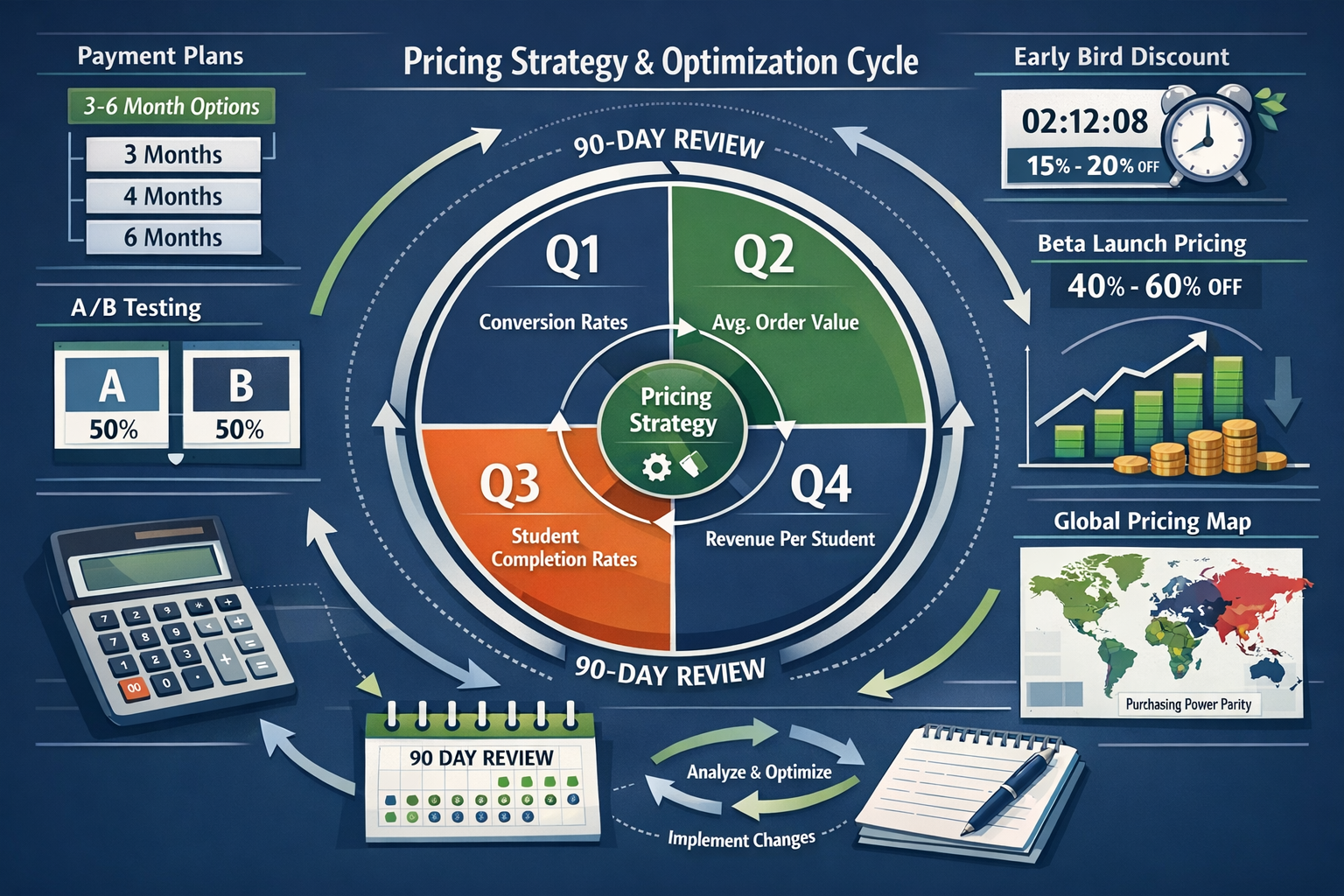
Phase 1: Beta Launch (40-60% Discount)
Your first 10-20 students get massive discounts in exchange for feedback and testimonials. This isn't charity—it's a value exchange[2].
If your planned price is $997, beta students pay $397-$597. They get early access, they help you refine the content, and you get testimonials that make selling at full price easier.
Position it honestly: "I'm testing this program with a small group. You get a huge discount, I get your feedback and a testimonial. Fair trade?"
Phase 2: Founding Member Launch (25-35% Discount)
After beta, you've got testimonials and refined content. Now you open to 50-100 "founding members" at $647-$747 (for that $997 course).
This creates urgency without training your audience to expect permanent discounts. Founding members get grandfathered pricing on future updates—that's their ongoing benefit.
Phase 3: Early-Bird Pricing (15-20% Discount)
For every subsequent launch, offer time-limited early-bird pricing for the first 72 hours or first 50 buyers[2]. This generates momentum and rewards action-takers.
Your $997 course becomes $797-$847 for early birds. After the deadline? Full price, no exceptions.
Phase 4: Full Price (With Strategic Bonuses)
Once early-bird closes, you're at full price. But you can still create urgency through limited-time bonuses instead of discounts:
- "Enroll this week and get the advanced templates bundle ($297 value)"
- "First 25 buyers get a private group implementation call"
- "Spring launch bonus: 30-day money-back guarantee extended to 60 days"
This maintains your price integrity while still giving fence-sitters a reason to act now.
The Discount Trap to Avoid
Never run constant sales. Never offer "flash discounts" every month. You'll train your audience to wait for discounts and destroy your pricing power[1].
If someone asks for a discount outside your strategic pricing windows? The answer is simple: "The price reflects the value. If you're not ready to invest at this level, start with the gateway tier."
That's not being mean. That's protecting your business and attracting committed students who get results.
Payment Plans and Pricing Psychology: Converting More Buyers Without Discounting
Here's a reality check: most people don't have $997 sitting in their checking account ready to drop on a course, even if they desperately need what you're teaching.
Payment plans solve this problem while actually increasing your revenue.
The Payment Plan Formula
For courses priced above $500, offer 3-6 monthly payments with a 10-15% premium over the full-pay price[2].
Example:
- Full pay: $997 (one payment)
- Payment plan: 3 payments of $397 ($1,191 total)
Why the premium? Processing fees, increased risk of chargebacks, and incentive for full payment. This isn't greedy—it's smart business.
The Conversion Math
Offering payment plans typically increases conversions by 15-30% for mid-ticket and high-ticket offers. That means instead of 100 sales at $997, you might get 125 sales with 60% choosing payment plans.
Let's do the math:
- No payment plan: 100 sales × $997 = $99,700
- With payment plan: (50 × $997) + (75 × $1,191) = $49,850 + $89,325 = $139,175
That's a 40% revenue increase just from offering flexible payment options.
Anchoring Your Price Points
Price anchoring is the psychological principle that guides how people perceive value[1]. When you show multiple options, the middle option becomes the "reasonable" choice.
Here's how to structure your pricing page:
Option 1: Self-Paced ($297)
- Course modules only
- Email support
- Lifetime access
Option 2: Accelerator ($997) ⭐ MOST POPULAR
- Everything in Self-Paced
- Community access
- Monthly group coaching
- Templates and swipe files
Option 3: VIP ($2,497)
- Everything in Accelerator
- Weekly accountability calls
- Private feedback on your work
- Done-with-you implementation
Most people will choose Option 2 because it looks like the best value compared to the extremes. But here's the genius: Option 3 makes Option 2 look affordable, even though $997 is your real profit center.
Geographic Pricing (PPP) for Global Reach
In 2026, Purchasing Power Parity (PPP) pricing is becoming standard practice. This means automatically adjusting prices based on the buyer's location[2].
Someone in India or the Philippines might see your $997 course at $397-$597 (40-60% discount) while US buyers pay full price. This expands your addressable market without devaluing your course in primary markets.
Platforms like Gumroad, Teachable, and Thinkific now support automatic PPP pricing. If you're not using it, you're leaving international revenue on the table.
The Implementation Premium: Why Group Support Commands 3-10x Higher Pricing
Here's what actually works in 2026: selling transformation, not information.
The shift from DIY courses to implementation-focused offers is the biggest pricing opportunity most creators are missing.
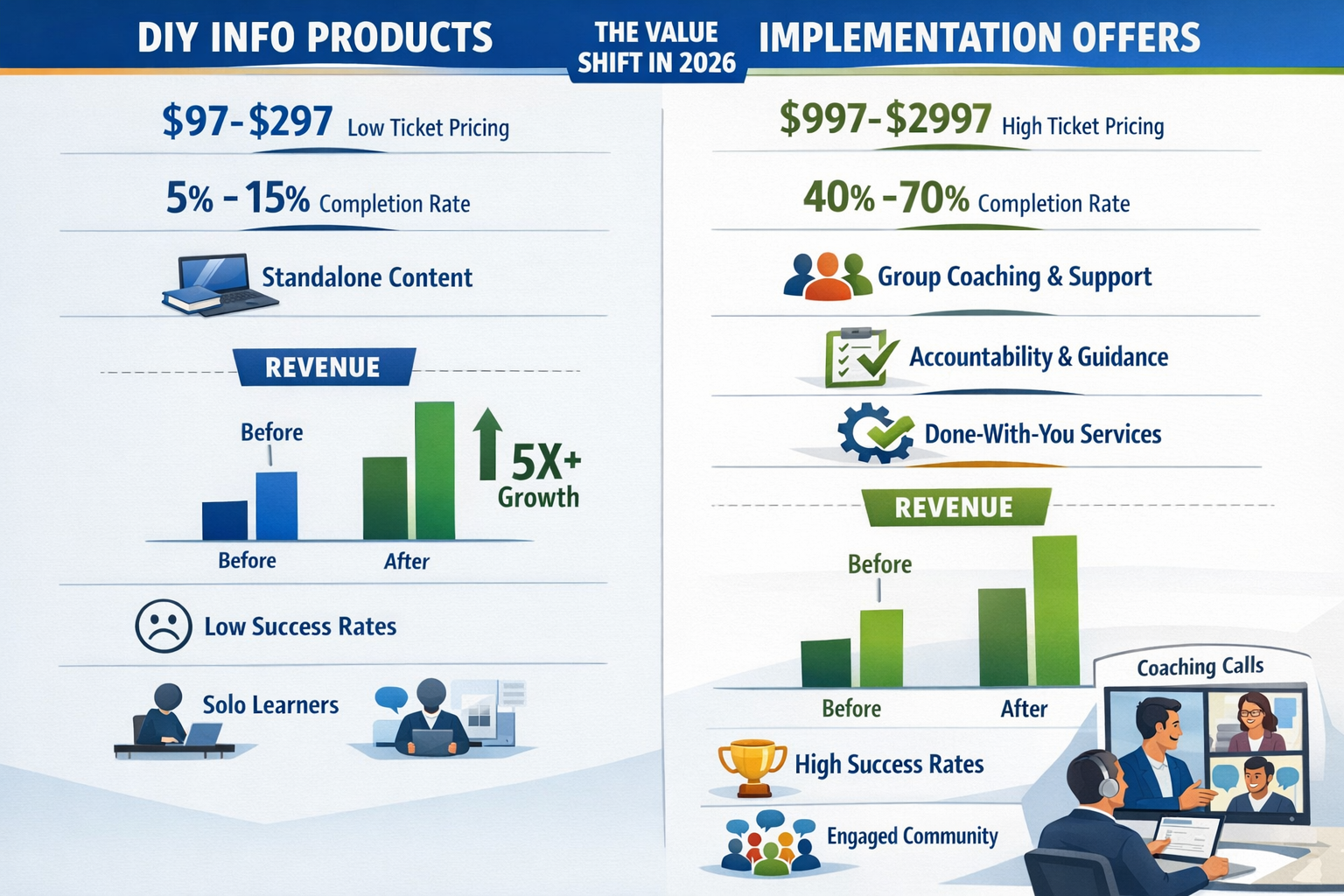
The DIY Information Model (Dying)
Traditional course model:
- Record videos explaining concepts
- Price at $97-$297
- Students watch alone
- 5-15% completion rate
- Minimal results
- No word-of-mouth growth
This model is commoditized. Students can find similar content on YouTube for free or pay $10/month for a platform subscription.
The Implementation Model (Thriving)
Modern high-value model:
- Core training + group implementation
- Price at $997-$2,997
- Students work together in cohorts
- 40-70% completion rate
- Measurable results
- Strong referral engine
The difference? Accountability, community, and done-with-you support[2].
How to Add Implementation Elements
Weekly Accountability Calls: Every Monday, students submit what they accomplished and commit to next week's goals. Public accountability drives action.
Group Work Sessions: Live Zoom sessions where everyone works on the same task together. You provide real-time feedback and answer questions as they implement.
Peer Review Systems: Students review each other's work using your rubric. This creates engagement and provides feedback without requiring your time for every student.
Progress Milestones: Break your course into implementation checkpoints. Students can't access Module 4 until they complete the Module 3 assignment. This forces action and prevents consumption without implementation.
Results Showcases: Monthly calls where successful students share their wins. This builds proof, motivates others, and creates case studies for your marketing.
The Pricing Math on Implementation
A self-paced course teaching Facebook ads might sell for $297. Add weekly group calls, a private community, and template customization? Now you're at $997-$1,497.
Same core content. 3-5x the price because you've shifted from information delivery to transformation facilitation.
That's the implementation premium, and it's how you build real online income instead of competing on price with every other course creator.
Quarterly Pricing Reviews: When and How to Raise Your Prices
Here's what nobody talks about: your pricing should evolve as you add value and build proof.
The mistake? Setting your price once and never touching it, even as you improve the course, add bonuses, and stack testimonials.
The 90-Day Review Cycle
Every quarter, evaluate these metrics:
Conversion Rate: What percentage of your audience is buying? If you're converting 5%+ consistently, you have room to raise prices. If you're under 2%, your messaging or audience targeting needs work—not necessarily your price.
Revenue Per Student: Track total revenue divided by total students. If this number is increasing (through upsells, payment plans, or higher-tier purchases), your pricing strategy is working.
Student Quality: Are buyers taking action? Completing the course? Getting results? High-quality students who get results are worth more than bargain hunters who never implement.
Completion Rate: If 40%+ of students are finishing your course and getting results, you're underpriced. Raise your prices and use those results as proof.
When to Raise Prices
Raise your prices when:
- You've added significant new content or bonuses
- You have 10+ strong testimonials and case studies
- Your conversion rate is consistently above 4-5%
- You're getting more demand than you can handle
- Your completion rates prove the program works
Don't raise prices because you need money. Raise them because you've increased the value and proven the results[2].
How Much to Raise
Increase prices by 15-25% per iteration, not massive jumps. This feels reasonable to your audience and allows you to test price sensitivity.
Example progression:
- Launch 1 (Beta): $397
- Launch 2 (Founding): $497
- Launch 3 (Early-bird): $597
- Launch 4+ (Full price): $697-$797
Over four launches, you've nearly doubled your price while continuously proving value. That's strategic pricing, not random guessing.
Grandfathering Previous Buyers
When you raise prices, honor previous buyers with grandfathered rates on future updates. This builds loyalty and creates advocates who promote your course because they got an amazing deal.
"I paid $497 for this course, and it's now $997. Best investment I made" is powerful social proof.
Competitor Analysis Without the Comparison Trap
Let's address the elephant in the room: should you base your pricing on what competitors charge?
Short answer: No.
Longer answer: Research competitors to understand market positioning, but price based on YOUR value delivery, not theirs[1].
What to Research
Pricing tiers: What price points are competitors using? This gives you market benchmarks, not pricing instructions.
Value stacks: What are they including at each tier? Templates? Community? Coaching? This shows you what's expected at different price points.
Completion rates: If competitors share this data (or students mention it in reviews), it reveals whether higher-priced courses actually deliver better results.
Student reviews: What do buyers complain about? What do they rave about? This shows gaps you can fill and value you can emphasize.
The Positioning Decision
You have three positioning options:
Budget Option (10-30% below market): You'll get higher volume but lower-quality students. Only choose this if you have a clear upsell path to higher-ticket offers.
Market Rate (within 10% of average): You'll blend in. Fine if your marketing and proof are exceptional, but you're competing primarily on trust and authority.
Premium Option (30-100%+ above market): You'll get lower volume but higher-quality students who are serious about results. This requires exceptional proof and positioning.
Most course creators should aim for market rate initially, then shift to premium as they build proof and refine their program.
The Comparison Trap
Here's where it gets dangerous: constantly comparing yourself to competitors and adjusting prices based on fear.
"They're charging $497 and have 1,000 students, so I should charge $297 to compete…"
Stop. That's a race to the bottom.
Instead, ask: "What unique value do I deliver that justifies my price?" Then communicate that value relentlessly in your marketing.
Your competitor might have 1,000 students and a 5% completion rate. You might have 100 students and a 60% completion rate. Which course is actually worth more?
Subscription vs. One-Time Pricing: Choosing Your Revenue Model
The final piece of the pricing puzzle: should you charge once or build recurring revenue?
Both models work in 2026, but they serve different purposes and require different strategies.
One-Time Pricing ($47-$5,000)
Best for: Transformation-focused courses with clear endpoints, high-ticket programs, cohort-based launches.
Pros:
- Higher upfront revenue
- Easier to sell (clear value exchange)
- No ongoing delivery obligation
- Works well for affiliate marketing funnels
Cons:
- Revenue stops when you stop launching
- No recurring income stability
- Harder to justify continuous engagement
Pricing sweet spots: $297-$997 for comprehensive courses, $1,997-$5,000 for implementation programs.
Subscription Pricing ($20-$299/month)
Best for: Ongoing communities, continuous content delivery, evolving skill development, accountability programs.
Pros:
- Predictable recurring revenue
- Builds long-term student relationships
- Justifies continuous content creation
- Lower barrier to entry
Cons:
- Requires ongoing content and engagement
- Higher churn risk if value drops
- Takes longer to reach revenue goals
Pricing sweet spots: $27-$47/month for content libraries, $97-$197/month for community + coaching, $297+/month for done-with-you support.
The Hybrid Model (Best of Both)
Here's what actually works for maximum revenue: combine both models.
Offer your core course as a one-time purchase ($497-$997), then upsell a monthly membership for ongoing support, advanced training, and community access ($47-$97/month).
Example structure:
- Core Course: $697 one-time (all training modules, templates, lifetime access)
- Implementation Community: $67/month (weekly coaching calls, private community, monthly advanced trainings)
Students who complete your course and get results will naturally want continued support. You're not leaving money on the table—you're providing ongoing value.
Calculating Lifetime Value
With the hybrid model, your lifetime value per customer explodes:
- One-time purchase: $697
- Average subscription length: 8 months
- Monthly subscription: $67
- Total LTV: $697 + ($67 × 8) = $1,233
That's 77% more revenue per customer just by offering ongoing support.
This is how you build a sustainable online income instead of constantly chasing new launches.
Putting It All Together: Your 2026 Pricing Action Plan
Alright, enough theory. Here's what actually works—the step-by-step framework for pricing your course for maximum revenue in 2026.
Step 1: Define Your Value Stack (Week 1)
List everything you're including:
- Core training modules
- Templates and resources
- Community access
- Coaching/support level
- Guarantees and bonuses
Assign realistic value to each component based on market research and competitor analysis[1].
Step 2: Choose Your Pricing Model (Week 1)
Decide between:
- Single tier: One price, one offer (simplest but leaves money on table)
- Tiered pricing: 3-5 options at different price points (recommended for most)
- Subscription: Monthly recurring (best for ongoing communities)
- Hybrid: One-time + subscription (maximum LTV)
Step 3: Set Your Beta Pricing (Week 2)
Calculate your eventual full price, then offer 40-60% off for your first 10-20 beta students[2]. Make it clear this is a limited opportunity in exchange for feedback and testimonials.
Step 4: Launch and Collect Data (Weeks 3-8)
Track these metrics obsessively:
- Conversion rate (visitors to buyers)
- Completion rate (buyers who finish)
- Results rate (students who achieve the outcome)
- Feedback themes (what's working, what's not)
Step 5: Refine and Raise (Week 9+)
Based on your data:
- If conversion rate is 5%+: Raise prices 15-25%
- If completion rate is 40%+: Add implementation elements and raise prices
- If you have 10+ testimonials: Move to founding member pricing
- If demand exceeds capacity: Raise prices or add premium tier
Step 6: Quarterly Reviews (Every 90 Days)
Set calendar reminders to review:
- Are you adding enough value to justify higher prices?
- Do you have new proof (testimonials, case studies, results)?
- Has your conversion rate stabilized at a healthy level?
- Should you test new pricing tiers or payment options?
Pricing is not set-it-and-forget-it. It's an ongoing optimization process that evolves with your business.
Conclusion: Stop Guessing, Start Testing
Here's the truth about how to price online courses for maximum revenue in 2026: there's no perfect price, only tested prices.
The course creators making real money aren't the ones with the fanciest sales pages or the most videos. They're the ones who:
- Build pricing ladders that meet buyers at different commitment levels
- Stack genuine value instead of competing on price alone
- Add implementation support that justifies premium pricing
- Test and iterate based on data, not fear
- Focus on transformation instead of information delivery
The shift from DIY information products to implementation-focused offers is the biggest pricing opportunity in 2026. A $97 course with no support will always struggle against a $997 program with group coaching, accountability, and done-with-you implementation.
Your next steps:
- Audit your current pricing against the frameworks in this article
- Map out a 3-tier pricing structure with clear value differences
- Add one implementation element (group calls, community, templates) that justifies higher pricing
- Set a 90-day review date to evaluate conversion rates and student results
- Stop consuming, start building—test your pricing in the real market, not in research mode
The difference between a $10k/month course business and a $100k/month course business often comes down to pricing strategy, not content quality.
You've got the knowledge now. The only question is: will you take action or keep researching?
Because here's what took me 10+ years to figure out: consistent imperfect action beats perfect planning every single time.
Price your course, launch it, collect data, iterate. That's how you build real revenue, not by finding the "perfect" price in another blog post.
Now go build something.
References
[1] How To Price Your Online Course – https://wedevs.com/blog/488871/how-to-price-your-online-course/
[2] Online Course Pricing Guide – https://buddyboss.com/blog/online-course-pricing-guide/
[3] Pricing Strategies For Online Courses – https://www.learnworlds.com/pricing-strategies-for-online-courses/